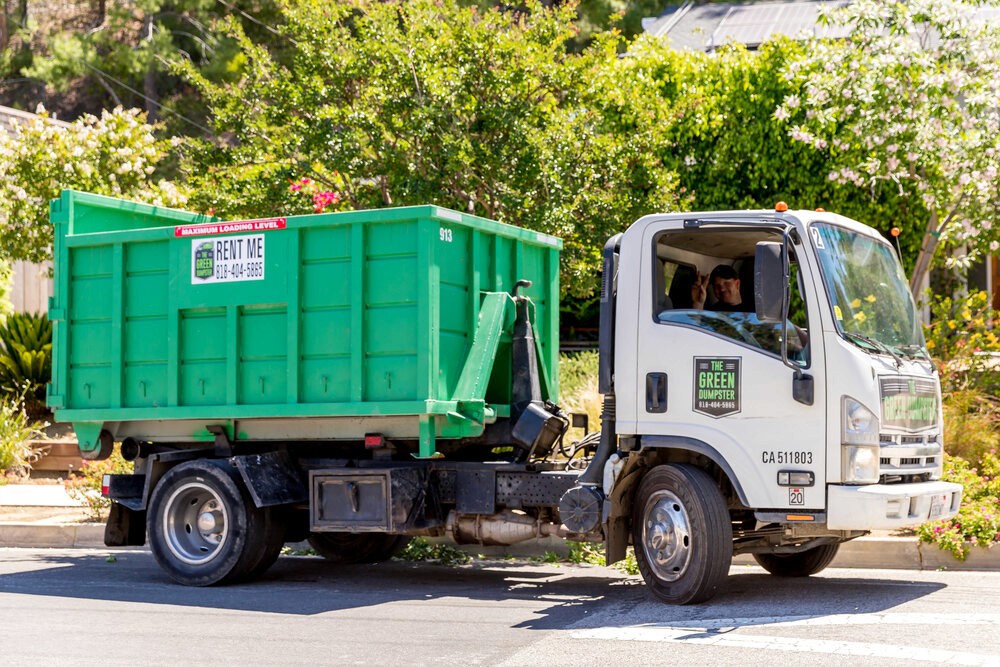
A bin full of cardboard and a bin full of drywall weigh nothing alike, which is exactly where dumpster weight limits start to bite.
Every rental comes with an "included tonnage" baked into the flat price, and going over it shows up as a per-ton charge after the bin gets weighed at the landfill.
Here's how the limits work by size, how to estimate your load, and how to stay under.
Key Notes
Roll-off weight limits range from 1–3 tons on a 10-yard to 5–6 tons on a 40-yard.
A cubic yard of concrete weighs up to 10x more than a cubic yard of yard waste.
Overage fees typically run $50–$100+ per extra ton, prorated by actual weight.
How Do Dumpster Weight Limits Work?
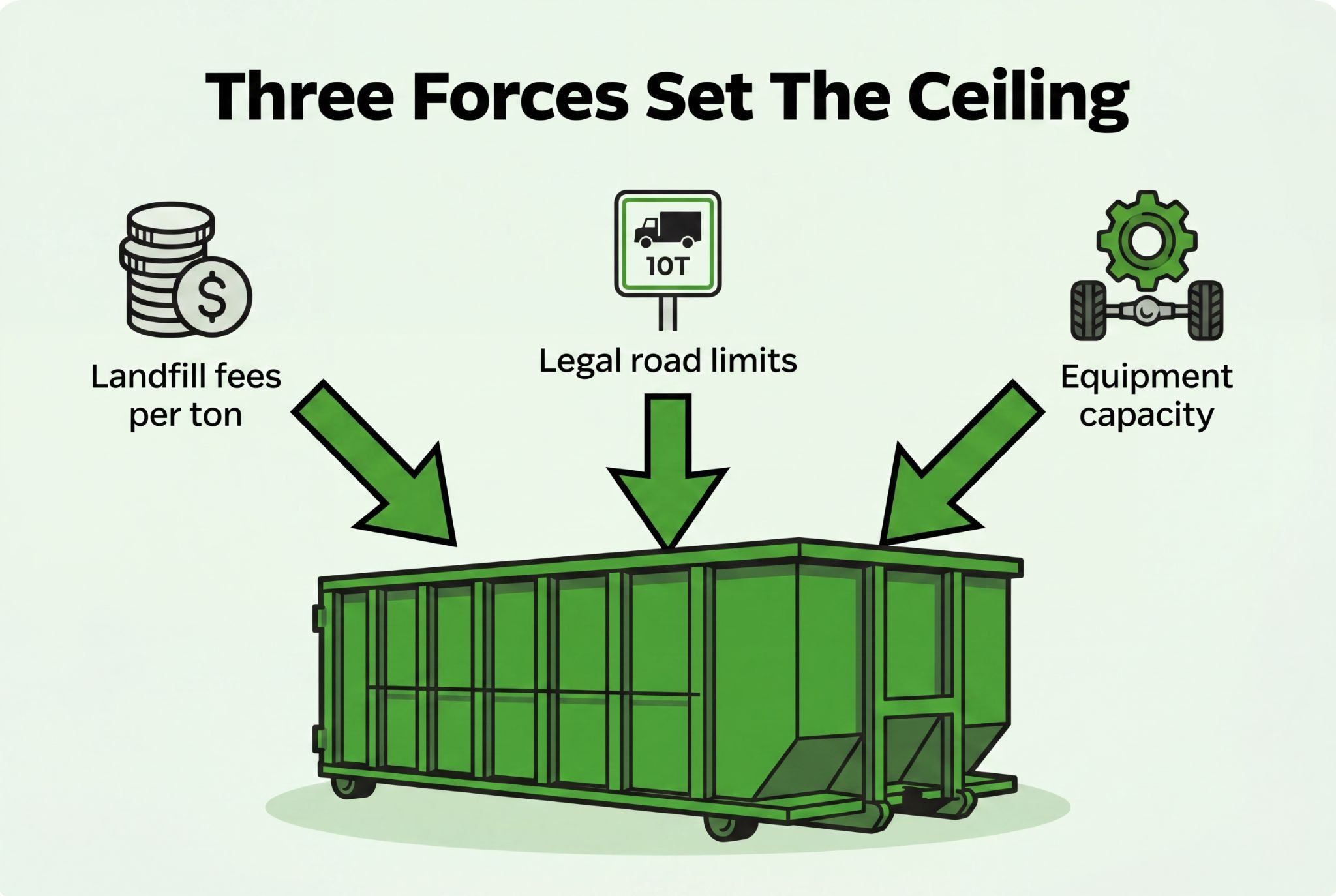
Dumpster weight limits exist because three things have to line up on every job:
the landfill has to accept the load
the truck has to legally haul it
the price you were quoted has to still work for the hauler
When a roll-off goes over its limit, all three start breaking down at once.
Why The Limits Exist In The First Place
Three forces set the ceiling on what a dumpster can hold – and all three have to be respected before a bin can legally roll out of your driveway.
How The Weight Is Measured
Every dumpster gets weighed at a certified scale at the landfill or transfer station after pickup.
The process is straightforward:
The truck arrives loaded and gets weighed on the scale.
The bin gets dumped.
The empty truck gets weighed again.
The difference between the two readings is your debris weight on the scale ticket.
That ticket is what billing runs off. Nothing's estimated by eye, and there's no fudging it at the curb.
Why Dumpster Weight Limits Aren't Standardized
Two haulers can offer the same 20-yard bin with completely different included tonnages because their trucks, landfills, and pricing structures aren't the same.
That's why size charts always show ranges instead of fixed numbers (and why it pays to confirm your tonnage in writing before booking).
Typical Dumpster Weight Limits By Size
Bigger dumpsters include more tons, but not proportionally – a 40-yard doesn't haul four times what a 10-yard does because the truck has a ceiling either way.
Here's a quick reference for typical residential roll off dumpster weight limits:
Size | Typical Included Weight | Best For |
4 yard | ~800–1,500 lbs | Ongoing trash service, not project debris |
10 yard | 1–3 tons (2,000–6,000 lbs) | Bathroom demos, small roofing, heavy debris |
15 yard | 1–3 tons | Kitchen remodels, mid-size cleanouts |
20 yard | 2–4 tons (4,000–8,000 lbs) | Most home cleanouts, multi-room remodels |
30 yard | 3–5 tons (~10,000 lbs) | Whole-house cleanouts, large renovations |
40 yard | 5–6 tons (10,000–12,000 lbs) | Big commercial jobs, bulky lighter debris |
The 4 Yard Dumpster Weight…
Sits in a different category from the rest.
These are front-load bins for ongoing trash service at restaurants and offices, not project bins, and they're usually rated in pounds rather than tons.
The 10 Yard Dumpster Weight Limit Is Deceptively Useful
It's small, but the tonnage allowance per cubic yard is often higher than larger bins, which is why it gets used for heavy stuff like concrete and roofing tear-offs.
When People Ask How Much Can A 15 Yard Dumpster Hold:
It depends on what you're putting in it.
A 15-yard packed with cardboard might not hit 1 ton.
A 15-yard half-full of soil could blow past 3 tons easily.
The 20 Yard Dumpster Weight Limit Is The Sweet Spot For Most Homeowners
It's the default for typical home cleanouts because the 2–4 ton allowance covers mixed household debris without forcing you up to a 30.
The 30 Yard Dumpster Weight Limit Is Where Things Get Interesting
Volume goes way up but tonnage only ticks up modestly (because at that point the truck's the bottleneck, not the bin).
The 40 Yard Dumpster Weight Limit…
Is the clearest example of why bigger isn't always better.
Despite the massive volume, you're still capped at roughly 5–6 tons. That's why concrete, dirt, and brick are usually banned from 30s and 40s – a full bin would exceed legal road weight long before it reached the rim.
How To Estimate Your Debris Weight Before You Book
Weight depends on what you're throwing away, not how much space it takes up.
A 20-yard packed with cardboard and a 20-yard packed with drywall are two completely different scale tickets.
Here's a workable estimate process:
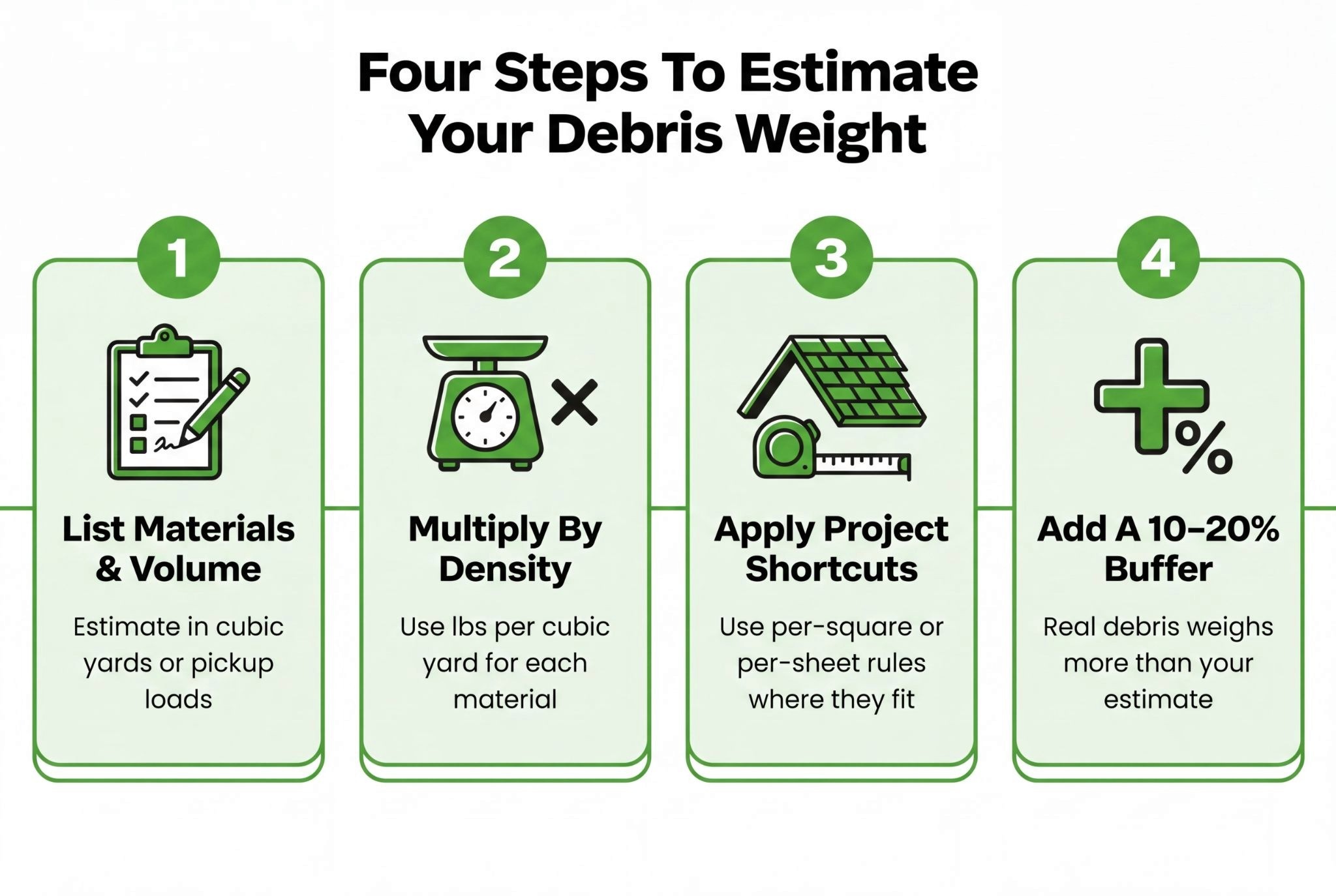
Step 1: List Your Main Materials & Rough Volume
Think in cubic yards or pickup truck loads.
A standard pickup bed is roughly 2.5 cubic yards. One gutted bathroom is usually 1–2 cubic yards of debris. One stripped roof of a 1,500 sq ft house is around 15–18 squares of shingles.
Step 2: Multiply By Typical Density
These are rough lbs-per-cubic-yard numbers that get you in the ballpark:
Concrete or asphalt: 2,000–4,000 lbs
Brick or stone: 2,800–3,000 lbs
Dirt or soil: 2,600–3,000 lbs
Drywall: 500–800 lbs (a single 4×8 half-inch sheet is ~50 lbs)
Mixed construction debris: 400–600 lbs
General household junk: 300–400 lbs
Yard waste and leaves: 250–300 lbs
Divide the total by 2,000 to convert to tons.
Step 3: Use Project-Specific Shortcuts When You Can
For roofing, asphalt three-tab shingles run roughly 180–240 lbs per "square" (100 sq ft of roof). Architectural shingles are a bit less per bundle but heavier per piece.
For carpet, figure 5–20 lbs per square yard depending on thickness and padding.
Step 4: Add A 10–20% Buffer
Real debris is never as tidy as your estimate. Moisture, surprise items behind the garage workbench, the leftover tile you forgot was stacked in the closet – it all adds up.
Treat your number as a floor, not a ceiling.
What Happens If You Go Over Dumpster Weight Limits?
Going over a dumpster weight limit lands somewhere on a sliding scale – a small overage means a per-ton charge added to your invoice, while a serious overload means a refused pickup, a trip fee, and a delay.
Here's what each scenario looks like:
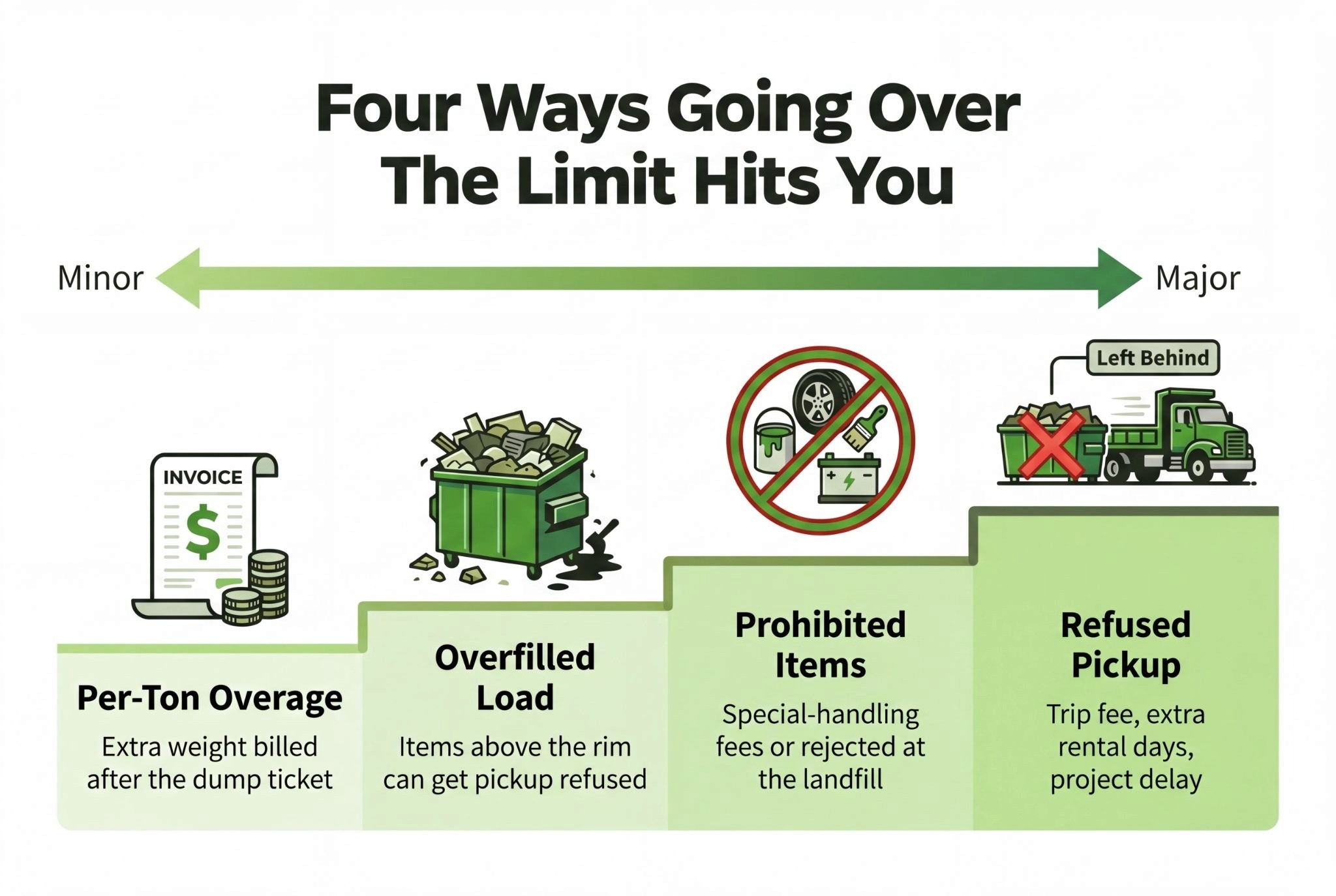
The Standard Case: Per-Ton Overage On Your Invoice
If your bin comes in modestly over the included tonnage, the hauler bills the difference after the dump ticket comes back. Nothing more dramatic than that.
Typical rates run $50–$100+ per extra ton, usually prorated by the actual weight
Example: 1.4 tons over at $60 per ton works out to $84, not $120 (no rounding up to a full ton)
The charge gets added to your invoice after pickup
The Bigger Problem: A Refused Pickup
When a bin is visibly overloaded, structurally stressed, or exceeds the truck's safe and legal weight, the driver leaves it on site.
This is where a small problem turns into a real delay:
A trip fee for the failed pickup attempt
Extra rental days charged while the bin sits in your driveway
You still have to remove material before the driver can come back
A short delay can stretch into a week, depending on schedules
Refused pickups aren't a punishment – they're a hauler protecting their truck and staying on the right side of road weight laws.
Overfilled Is Its Own Separate Problem
Loading above the rim is a different issue from going over on weight, and it can get your pickup refused even if your tonnage is fine.
California Vehicle Code §23114 prohibits hauling loads that can shift or spill on the road. Items poking above the top rail violate that rule, regardless of what the scale ticket says.
Keep everything below the fill line.
Prohibited Items Add A Third Layer Of Fees
Standard roll-offs aren't allowed to take certain materials, and tossing them in can mean special-handling fees stacked on top of any overage charges – or the load being rejected at the landfill entirely.
Items that need their own disposal channel:
Tires
Batteries
Paints and solvents
Hazardous waste
Refrigerant-containing appliances
Most electronics
When in doubt, ask before you load.
How To Stay Under Dumpster Weight Limits?
Most overage problems on a dumpster rental trace back to two decisions: picking the wrong size or mixing the wrong materials.
Both are fixable before the bin shows up – here's how to get it right the first time:
Match The Size To The Material, Not Just The Volume
Picking a bin by volume alone is how heavy debris ends up triggering weight limit overages.
The fix is matching the size to what you're throwing away:
Heavy debris (concrete, brick, dirt, masonry) belongs in smaller, denser-rated bins
Bulky but light material (furniture, drywall, cardboard, yard waste) is what the bigger sizes are built for
Mixed projects usually need more than one bin – tearing out a patio and a basement at the same time is two different jobs
Load The Bin The Right Way
How you fill the dumpster affects both weight distribution and whether the driver can safely haul it:
Heaviest and bulkiest items go in first to build a flat, stable base
Spread weight evenly front to back – no concentrated hot spot on one end
Break down bulky pieces like cabinets and framing to close air gaps
Light, loose stuff fills in last, tucked into the gaps on top
A hot spot of dense material on one end makes the bin harder and more dangerous to lift, which can get a pickup refused even when total weight is fine.
Keep Your Material Streams Separated
Mixing categories usually costs more than handling them separately, and some combinations will get a load rejected at the landfill:
Hazardous materials, tires, electronics, and refrigerated appliances need their own disposal channels
Clean concrete or clean dirt typically needs a dedicated heavy-debris bin
Recyclables (clean metal, cardboard) are often cheaper to handle in their own stream when separate options are available
Cover The Bin If Rain's Coming
Water weight is the silent killer of debris estimates. A tarp is cheap insurance against a surprise overage charge.
Still Doing The Weight Math In Your Head?
Send over your project details and we'll size it correctly.
Dumpster Weight Limits FAQs
How much does a dumpster weigh empty?
An empty roll-off dumpster weighs anywhere from 1,500 lbs for a 10-yard to around 6,000 lbs for a 40-yard. That empty weight (the "tare weight") gets subtracted at the landfill scale, so it never counts against your included tonnage – you're only billed for the debris you loaded.
What is the heaviest item I can put in a dumpster?
The heaviest single items typically allowed in a standard roll-off are concrete chunks, masonry, and heavy furniture, as long as they stay within the bin's tonnage limit and a single piece can be safely loaded. Truly dense items like full vehicle engines, safes, or large industrial equipment usually need to be pre-approved with the hauler before loading.
Can you go over the weight limit on a dumpster?
You can technically go over the weight limit on a dumpster, but you'll pay a per-ton overage on top of your rental rate – and if the bin exceeds the truck's safe or legal haul weight, the driver can refuse pickup entirely. Small overages get billed quietly; serious overloads stall the project until material is removed.
Does a 20 yard dumpster need a permit?
A 20 yard dumpster doesn't need a permit if it's placed on private property like a driveway. Permits are only required when the dumpster sits on a public street, sidewalk, or alley – in Los Angeles, those run roughly $20–$150 through LA Public Works and need to be posted on the bin.
Conclusion
Dumpster weight limits stop being a mystery the moment you know three things: what you're throwing away, what it weighs per cubic yard, and how many tons your bin includes.
From there, every other decision falls into place – what size to book, how to load it, whether you need two bins instead of one, and which materials need their own disposal channel.
The overages that catch people off guard almost always come from skipping one of those three. A few minutes of estimation upfront and a clear conversation with your hauler is usually all it takes to avoid the whole problem.
If you'd rather hand the math off to someone who runs these numbers daily, send over your project details and we'll come back with tonnage, pricing, and the right bin in writing.