Double the size, double the price, double the space in your driveway – that's the gap between a 10 yard and 20 yard dumpster, give or take.
Pick wrong and you're either staring at an overflowing bin or paying for air.
The 10 yard vs 20 yard dumpster call really comes down to three things.
Here's how to nail your size, costs, placement, and the math behind it.
Key Notes
A 10 yard holds ~3 pickup loads and 2–3 tons; a 20 yard, double both.
Heavy debris like concrete needs a 10 yard – weight caps out before space does.
A 20 yard runs about 22 ft, so check driveway length before booking.
A 10 yard costs ~$520/week in LA; 20 yard around $620–$720.
Core Difference: 10 Yard vs 20 Yard Dumpster
The main difference between a 10 yard vs 20 yard dumpster is volume: a 20 yard gives you double the capacity.

The Part That Catches People Off Guard Is The Footprint:
Width is nearly identical. Both bins are about the width of a driveway, so this is never a "will it fit sideways" question.
Length is where they split. The 20 yard is noticeably longer and needs more driveway to sit on.
Height matters for loading. The 20 yard's taller walls mean you need more clearance above for the truck to set it down and pick it up.
So the real question isn't width, but whether you've got the length and overhead room.
Here's How They Stack Up:
10 Yard | 20 Yard | |
Volume | ~10 cubic yards | ~20 cubic yards |
Dimensions | ~12–14 ft L × 8 ft W × 3.5–4 ft H | ~22 ft L × 8 ft W × 4–4.5 ft H |
Pickup loads | ~3 | ~6 |
Typical weight limit | 2–3 tons | 3–4+ tons |
Best for | One room, heavy debris, tight spaces | Multi-room, bulky materials, renovations |
Match The 10 Yard vs 20 Yard Dumpster To Your Project
A 10 Yard Dumpster Is The Right Call For:
Single-room remodels – one bathroom (tile, drywall, a vanity) or a small kitchen facelift where you're swapping cabinets and counters but not gutting the room.
Garage, attic, or shed cleanouts that are cluttered but not packed wall-to-wall with furniture.
Yard waste like branches, shrubs, and small tree trimmings.
Small roof tear-offs, usually under about 1,500 sq ft.
Heavy, dense debris (concrete, dirt, brick, asphalt). More on why below, but the short version is that weight, not space, is your limit here.
A 20 Yard Dumpster Is The Better Fit For:
Full kitchen renovations with cabinets, countertops, old appliances, and drywall all going at once.
Multi-room cleanouts, basements, or a smaller whole-house declutter.
Roofing on an average-sized home – old shingles plus underlayment add up fast.
Siding or window replacement, where the materials are long and awkward.
Disaster cleanup after a flood or fire, with a mix of household items and building debris.
Got A Job With Both Heavy & Bulky Waste?
Keep the heavy stuff (concrete, dirt) in a 10 yard and the lighter, bulkier material separate – or go with a 20 yard but be disciplined about not loading it up with dense debris.
Why Weight Limits Decide The 10 Yard vs 20 Yard Dumpster Question
Volume and weight are two separate limits, and for heavy debris, the weight limit is the one you'll hit first (which is exactly why a bigger dumpster isn't always the better one).
The Typical Caps:
10 yard: around 2–3 tons
20 yard: around 3–4+ tons
On paper the 20 yard wins. But fill either bin with concrete or wet dirt and you'll blow past the tonnage long before you fill the space.
For Dense Material, Smaller Is Correct
A 20 yard packed with rubble is too heavy to legally haul, so it just sits in your driveway. A 10 yard keeps the load inside transportable limits and saves you from overage fees.
This Is Where A Low Boy Design Earns Its Keep
A low boy is a 10 yard with shorter walls built for heavy loads – you can wheelbarrow concrete or shovel dirt straight in instead of hoisting it over a tall side.
For driveway demo, dirt removal, or a concrete tear-out, that low wall is the whole point.
Space, Access & Placement: What To Check Before You Book Either Size
Before you commit to a 10 yard or 20 yard dumpster, walk your driveway – space is often the real deciding factor, not capacity.
The width is similar either way, so what you're really measuring is length and clearance.
Three Things To Check Before Delivery:
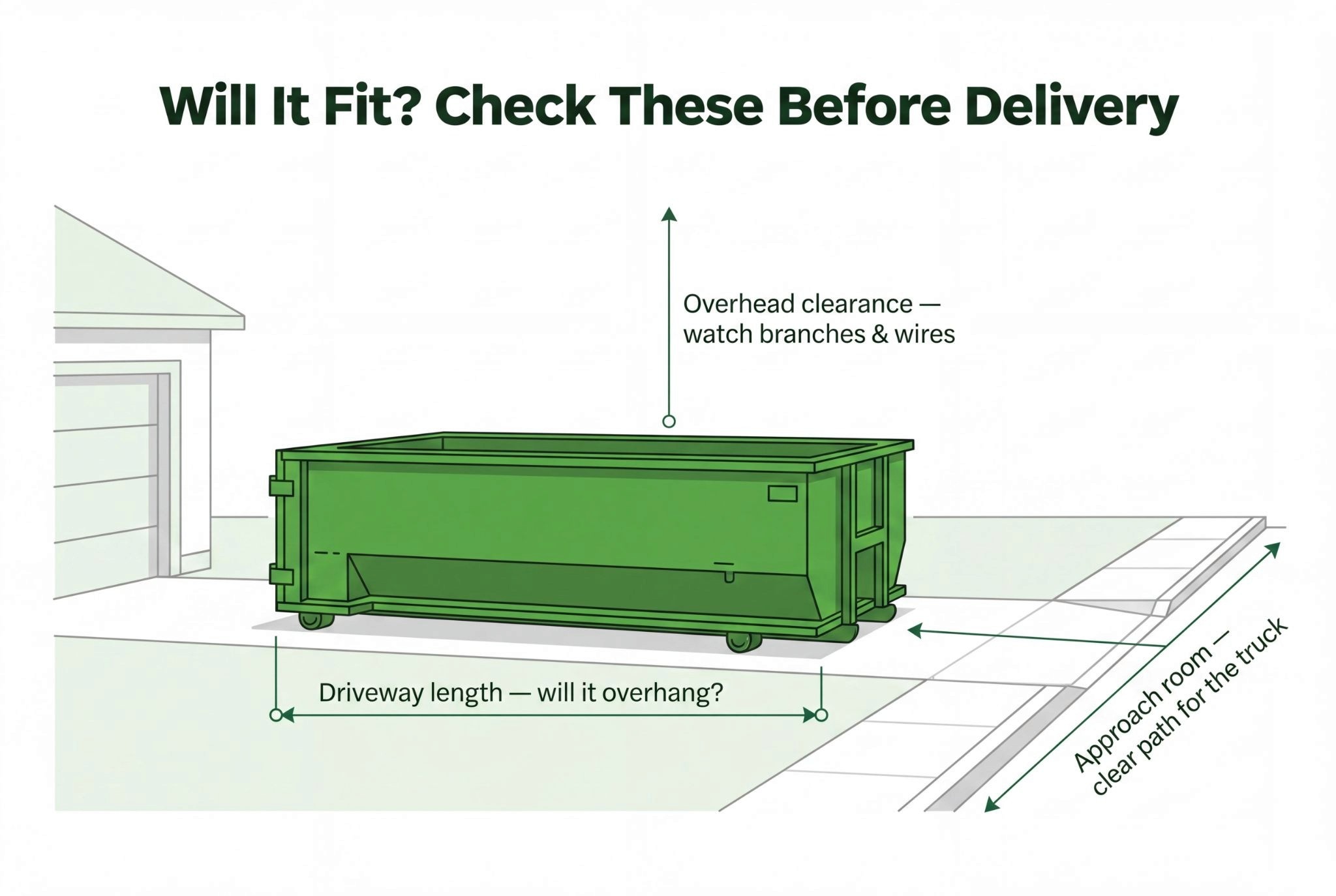
Driveway length. A 20 yard runs about 22 ft and will overhang a short drive into the sidewalk or street, which can mean a permit. A 10 yard tucks into tighter spots much more easily.
Overhead clearance. Low branches, wires, and carport roofs all get in the way when the truck lifts and lowers the bin.
Approach room. The truck needs a clear, straight shot to set the dumpster down and pick it back up.
The Simple Rule:
Short driveway, narrow street, or shared access → go 10 yard.
Plenty of room → a 20 yard gives you the buffer.
A Couple Of Things Worth Knowing On Placement:
Driveway protection is handled. Every 9-yard-and-up rental includes free heavy-duty protection pads, installed on delivery – no laying down plywood to keep your surface from getting scratched.
Street placement needs a permit. If the bin can't go on private property, that's a city permit.
10 Yard vs 20 Yard Dumpster Cost
A 10 yard dumpster runs around $520 per week in LA, and a "20 yard" job typically lands in the $620–$720 range depending on size and debris type. Pricing is local and depends on a few things, but those numbers give you a realistic frame for budgeting.
What Moves The Price Up Or Down:
Debris type. Concrete, dirt, and roofing cost more to dispose of than general household junk.
Rental length. Most rentals include 7–10 days; extra days run roughly $10–$50/day.
Location. Denser parts of LA carry higher disposal and fuel costs than the suburbs.
Access. Tight or blocked sites can mean a trip fee if the truck can't get in.
How To Choose Between A 10 Yard vs 20 Yard Dumpster In 3 Questions
Choosing between a 10 yard and 20 yard dumpster comes down to three quick questions – run through these and you'll have your answer:
1. Heavy or Bulky?
Dense debris (concrete, dirt, brick, shingles) → 10 yard, because you'll hit the weight limit fast.
Bulky but light (furniture, cabinets, lumber, carpet) → 20 yard, because you need the volume.
2. One Space or Several?
A single bathroom, small kitchen, or one-room cleanout → 10 yard.
Multiple rooms, a full kitchen, or a big declutter → 20 yard.
Tight Driveway or Open?
Short, narrow, or shared access → 10 yard.
Full-length driveway with room to spare → 20 yard.
And The Rule Of Thumb When You're Genuinely Torn:
Size up.
The cost of swapping in a second 10 yard almost always beats the savings of starting too small.
Still Stuck Between Two Sizes?
Get a fast quote and we'll help you pick the right one.
10 Yard vs 20 Yard Dumpster FAQs
How many cubic feet are in a 10 yard vs 20 yard dumpster?
A 10 yard dumpster holds about 270 cubic feet, and a 20 yard holds roughly 540 cubic feet. The "yard" refers to cubic yards, and one cubic yard equals 27 cubic feet – so the math is simply the yardage times 27.
Will a couch fit in a 10 yard dumpster?
Yes, a standard couch fits in a 10 yard dumpster with room to spare for other items. A 10 yard holds about 3 pickup loads, so a single sofa takes up a modest chunk – just break down or angle larger sectionals to save space for the rest of your haul.
How long can I keep a 10 yard or 20 yard dumpster?
Most dumpster rentals include a 7–10 day window, which covers the majority of home projects. Need more time? Extra days usually run about $10–$50 per day, so it's worth calling ahead if your timeline's slipping rather than scrambling at the end.
What can't I put in a 10 yard or 20 yard dumpster?
Hazardous materials are off-limits in any dumpster size – paints, solvents, oils, fuels, batteries, asbestos, tires, and most electronics. These need special disposal (LA has S.A.F.E. centers for household hazardous waste) so keep them separate to avoid prohibited-item fees.
Conclusion
When you're weighing a 10 yard vs 20 yard dumpster, three questions settle it: what you're tossing, how much of it, and how much driveway you've got.
Heavy, dense debris like concrete or dirt belongs in a 10 yard, where you'll hit the weight limit long before you run out of room. Bulky renovation and multi-room cleanout debris fits a 20 yard, where volume is the thing you're paying for.
And when you're genuinely torn, the bigger bin usually beats ordering a second haul.
Tell us about your project and we'll point you to the size that fits, with clear pricing and no surprises after delivery. Get a free quote and skip the guesswork.