Pick the wrong dumpster size and you're either paying for air or calling for a second haul halfway through the job.
The 20 vs 30 yard dumpster question trips up plenty of people, because the two bins take up nearly the same driveway space – the real difference hides in the height, the weight limits, and the price.
Here's how to choose the right one and what it'll run you.
Key Notes
A 20 yard holds ~6 truck loads, while a 30 yard holds ~9.
Both bins share a footprint – the 30 yard just stands taller.
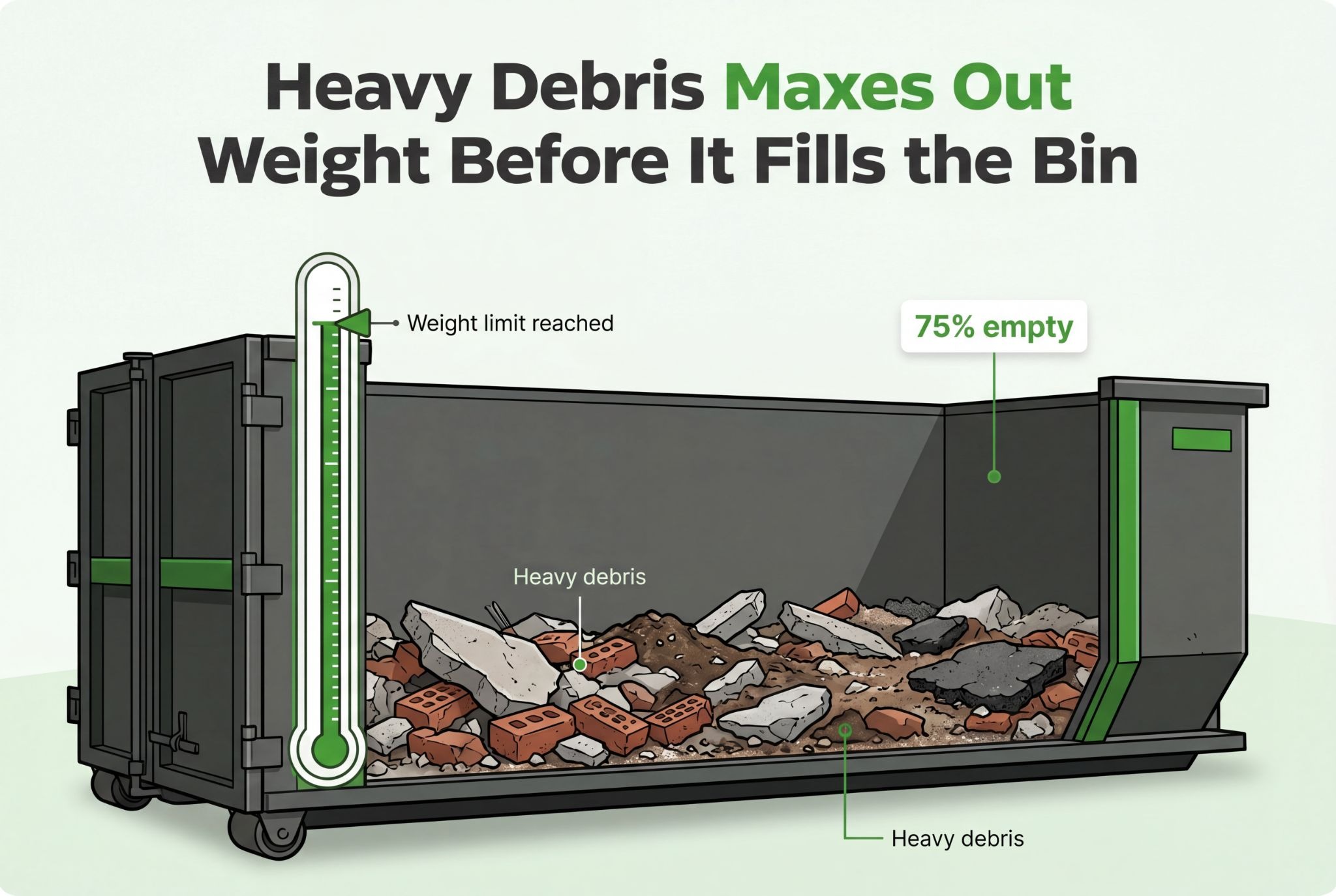
Dense debris like concrete hits weight limits long before filling the bin.
LA pricing runs roughly $520–$720 a week by size.
20 vs 30 Yard Dumpster At A Glance
When you're weighing a 20 vs 30 yard dumpster, the split comes down to volume and project size.
A 20 yard holds about 20 cubic yards of debris – roughly 6 pickup-truck loads.
A 30 yard holds about 30 cubic yards, or 9 pickup-truck loads.
Rule Of Thumb:
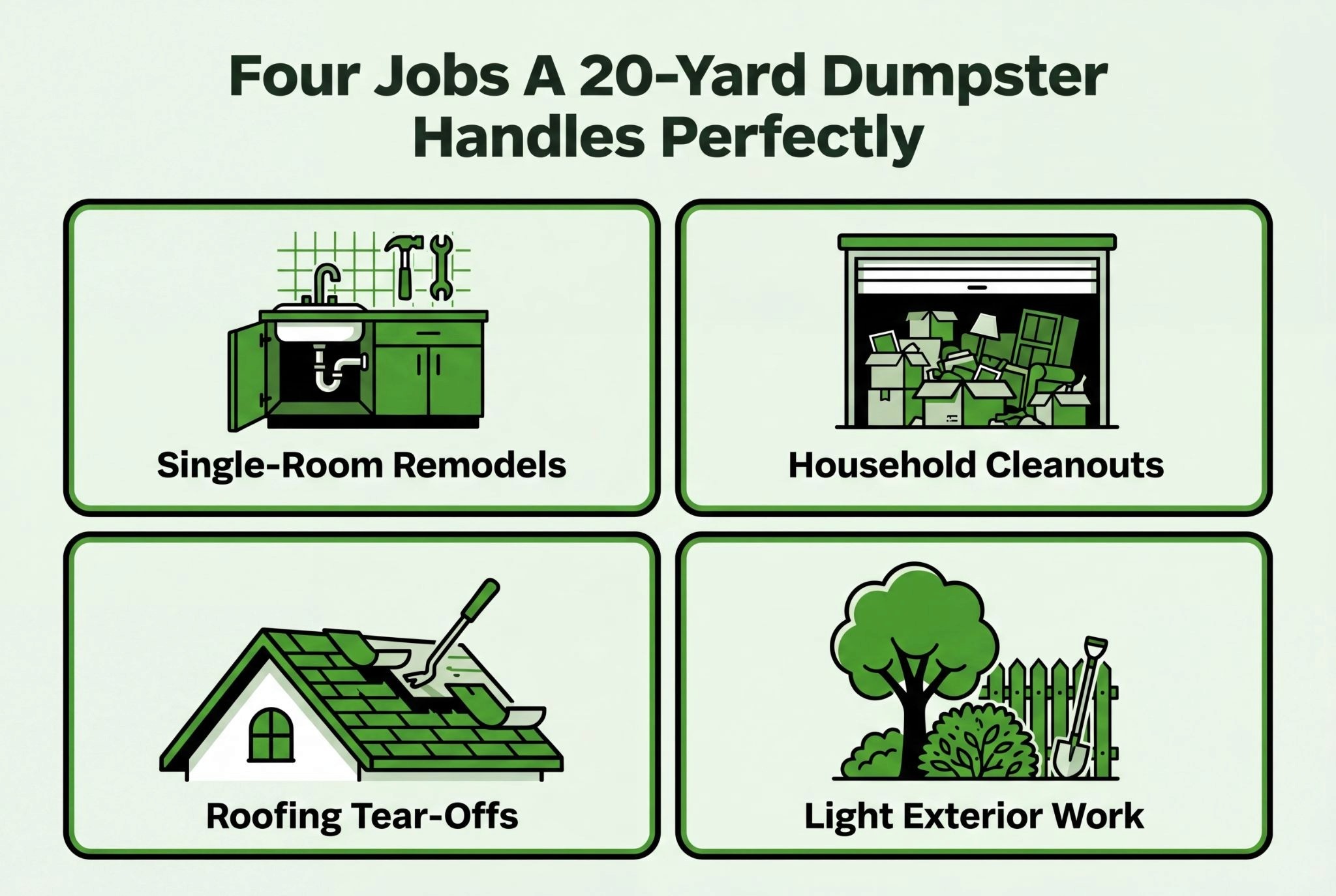
20 yard → medium projects (single-room remodels, a couple of bathrooms, garage and basement cleanouts)
30 yard → big projects (whole-home renovations, multi-room demo, estate cleanouts, ongoing construction debris)
Feature | 20 Yard Dumpster | 30 Yard Dumpster |
Typical dimensions | ~22' L × 8' W × 4–4.5' H | ~22' L × 8' W × 6' H |
Capacity | ~20 cubic yards / ~6 truck loads | ~30 cubic yards / ~9 truck loads |
Included weight | ~3–4 tons | ~4+ tons (up to ~10,000 lbs with some haulers) |
Project scale | Small–medium remodels & cleanouts | Large renos, construction, major cleanouts |
Loading | Easy to toss debris over the side | Usually need the walk-in door |
Main risk | Filling up faster than expected | Paying for space you don't use |
Size & Capacity: Why The Difference Is Height, Not Length
When you compare a 20 vs 30 yard dumpster side by side, the footprint barely changes – both run about 22 feet long and 8 feet wide.
The extra capacity in a 30 yard comes straight from the walls:
20 yard: ~4 to 4.5 feet tall
30 yard: ~6 feet tall
That foot-and-a-half of height drives the two things you'll notice.
Clearance Is About What's Overhead
Since the two bins sit on nearly the same patch of ground, a driveway that fits a 20 yard will almost always fit a 30 yard.
The delivery headaches come from above and to the sides:
Low tree branches
Power lines
How far your gate swings open
Loading Gets Harder As The Walls Get Taller
The lower sides on a 20 yard let you walk right up and toss debris over the edge.
A 30 yard's 6-foot walls change the game – for heavy or bulky stuff like a busted vanity, you'll want the walk-in door at the back instead of hoisting it overhead.
Good to know before you're standing there staring at a wall of steel.
Weight vs. Volume: The Mix-Up That Costs People Money
A bigger dumpster does not mean you can throw in heavier stuff.
Every roll-off comes with an included weight allowance, so a 20 vs 30 yard dumpster comparison has to account for tonnage on top of cubic yards:
20 yard: ~3–4 tons included
30 yard: ~4 tons or more, up to about 10,000 lbs with some haulers
So Pair The Two Questions In Your Head:
How much room do I need? Light and bulky stuff (furniture, drywall, cardboard) rewards a bigger bin.
How heavy is it going to be? Heavy and dense material rewards a smaller bin and a realistic look at the weight cap.
Nail that and you've got the single best defense against a surprise overage charge.
When A 20 Yard Dumpster Is The Right Call
Reach for a 20 yard dumpster when your project is solidly medium-sized – big enough to need real capacity, but not a full gut job.
When A 30 Yard Dumpster Is The Right Call
Go with a 30 yard dumpster when the project is clearly large and you'd rather not gamble on running out of room. The roughly 50% of extra volume over a 20 yard is what keeps a big job from turning into two hauls.
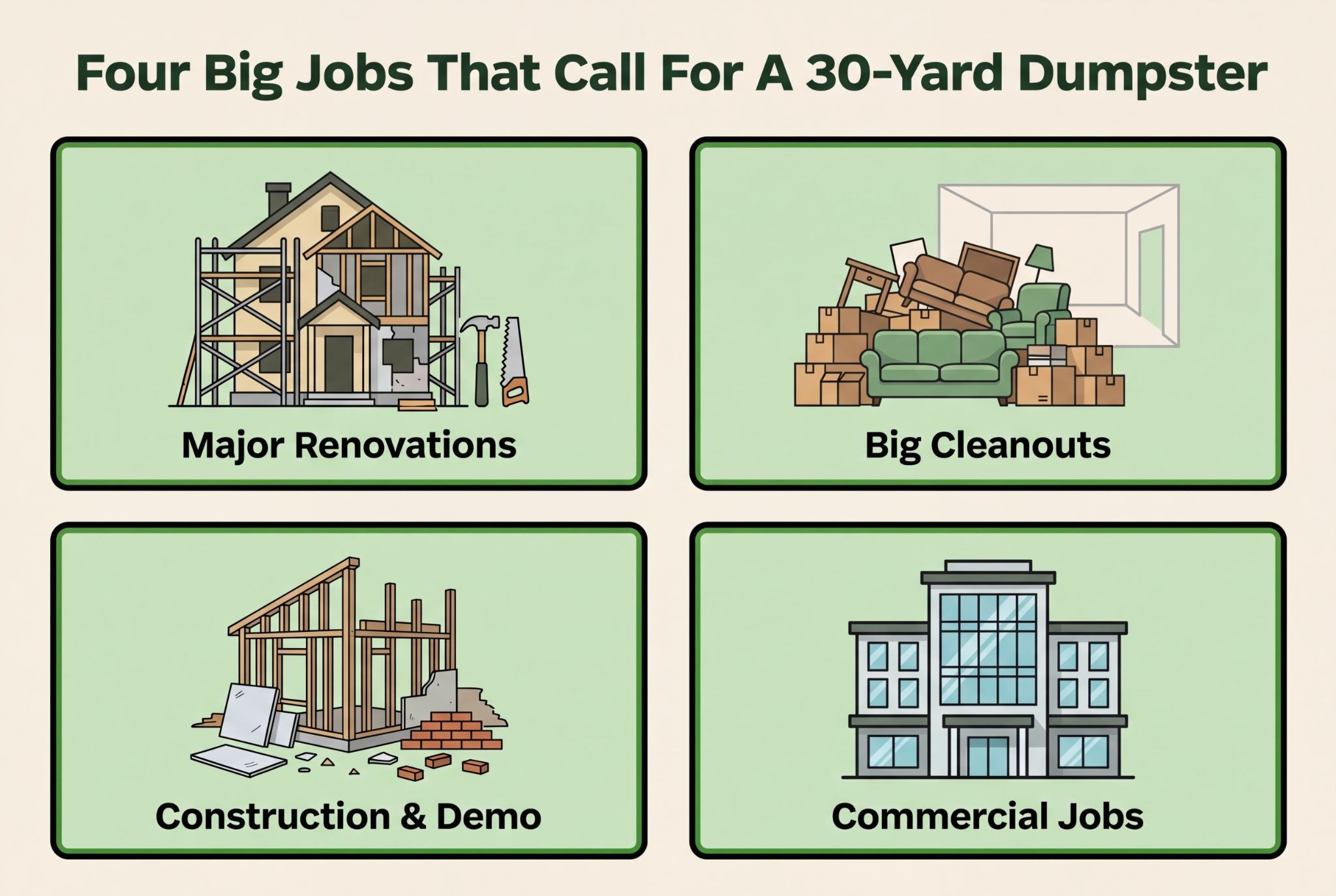
Two Things Make The 30 Yard Worth The Extra Cost On A Big Project…
It's forgiving – people almost always underestimate how much a long-owned home holds, and the headroom absorbs that.
And it handles awkward, oversized items (long lumber, large fixtures, bulky furniture) that a shorter bin struggles with.
What A 20 vs 30 Yard Dumpster Costs In LA
Dumpster rental pricing in Los Angeles runs by size and by week, and since a true 20 vs 30 yard dumpster isn't what we stock, here's how our actual sizes price out so you can read across.
As a 2026 ballpark in the LA area:
10 yard: ~$520/week
16 yard: sits between the 10 and 25
25 yard: ~$620/week
40 yard: ~$720/week
Those prices generally include delivery, pickup, and a set tonnage allowance.
One Money Tip For Large Jobs:
A single bigger bin usually beats renting two smaller ones.
If you're genuinely between sizes on a major project, sizing up once is often cheaper than paying for a second delivery, second haul, and second tonnage charge down the line.
Pick Your Dumpster Size In 3 Questions
Still on the fence between a 20 vs 30 yard dumpster?
Run through these three and you'll have your answer:
1. How Big Is The Project?
One or two rooms, a single roof, a garage cleanout → lean 20 yard.
Whole house, multiple large rooms, estate or hoarding cleanout, heavy construction → lean 30 yard.
2. How Dense Is The Debris?
Mixed household junk, furniture, drywall, lumber → scale by volume, either works.
Concrete, brick, or dirt → go smaller and respect the weight cap.
3. What's Your Space & Budget?
Tight driveway or cost-sensitive → the 20 yard is the safer baseline.
Big job with room to work → the 30 yard usually saves money by avoiding a second haul.
Still Stuck Between Two Sizes?
Tell us about your project and we'll match the right bin.
20 vs 30 Yard Dumpster FAQs
How many cubic feet is a 20 yard dumpster?
A 20 yard dumpster holds about 540 cubic feet, since one cubic yard equals 27 cubic feet (20 × 27). That works out to roughly 6 pickup-truck loads of debris.
How much does a 20 yard dumpster weigh empty?
An empty 20 yard dumpster weighs roughly 4,000 to 6,000 pounds on its own, depending on the manufacturer and steel gauge. That empty weight is separate from your included tonnage allowance – it's the bin itself, not what you're allowed to load.
How tall is a 30 yard dumpster?
A 30 yard dumpster stands about 6 feet tall, which is roughly a foot and a half higher than a 20 yard. That extra height is worth measuring against low branches, eaves, and power lines before delivery day.
How long can I keep a 20 or 30 yard dumpster?
Most 20 and 30 yard dumpster rentals come with a 7–10 day window included. Need more time? Extensions usually run $10–$50 a day, so it's worth flagging early if your project might run long.
Conclusion
Most of the 20 vs 30 yard dumpster decision comes down to three things: how big the job is, how heavy the debris runs, and how much space you've got to work with.
A 20 yard handles single-room remodels, garage cleanouts, and roof tear-offs without dominating your driveway. A 30 yard gives you roughly 50% more room for whole-home gut jobs, estate clearances, and steady construction debris.
The trap to sidestep is loading dense material like concrete or dirt into a big bin – weight limits fill up fast, and the overage charges follow.
Tell us what you're working on and we'll point you to the right size, with the weight allowance and full price spelled out before anything shows up. Get a free quote and lock in your bin in a couple of minutes.